
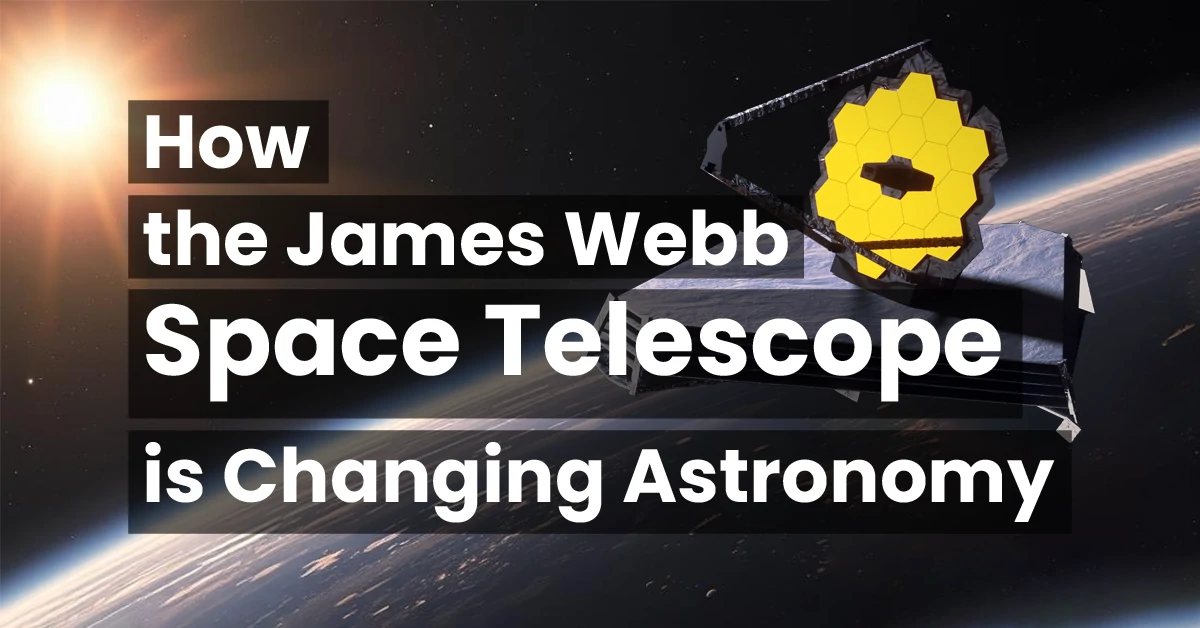
The James Webb Space Telescope (JWST) isn’t just a new eye in the sky—it’s a revolution in motion. Launched with the ambition to peel back the cosmic curtain, Webb is delivering a front-row seat to the universe’s grandest moments. From unravelling the secrets of ancient galaxies to decoding the atmospheres of distant exoplanets, it’s changing not only what we see, but how we see everything.
What Makes the James Webb Space Telescope So Special?
A closer look at its design, tech, and how it differs from Hubble
Webb isn’t just an upgrade—it’s a cosmic leap forward. While Hubble primarily captures light in the visible and ultraviolet ranges, Webb specializes in infrared. This allows it to peer through cosmic dust and spot things Hubble could never reach.
Its mirror, a gleaming 6.5 meters across, is more than two times larger than Hubble’s, capturing more light and delivering razor-sharp detail. Webb also orbits nearly a million miles from Earth at Lagrange Point 2, far beyond our Moon, where it can observe the universe without the interference of Earth’s heat or light. Its sunshield, roughly the size of a tennis court, keeps its instruments cryogenically cool—a vital necessity for accurate infrared readings.
Peeking Into the Cosmic Dawn
How Webb is revealing the universe’s first galaxies
The farther you look in space, the further back in time you go. Webb’s sensitivity lets it glimpse galaxies that formed just a few hundred million years after the Big Bang. These primordial structures are like the fossils of cosmic history, offering insight into how the first stars and galaxies assembled.
For the first time, scientists are seeing galaxy clusters still in the act of forming—messy, chaotic, and brimming with potential. These snapshots from the cosmic dawn are redefining how we think about the birth of structure in the universe.
Uncovering Hidden Corners of the Universe
Seeing through dust clouds to reveal stellar nurseries
Cosmic dust, while beautiful, has long obscured the view of star-forming regions. Webb’s infrared vision cuts through the murk to expose the engines of creation—stellar nurseries where young stars are being born.
These observations allow astronomers to watch stars in their earliest phases, cloaked in cocoons of dust and gas. With Webb, we’re not just seeing stars—we’re witnessing genesis.
Hunting for Alien Worlds
How Webb is transforming the search for exoplanets
Thousands of exoplanets have been discovered over the last few decades, but until now, most were little more than shadows and numbers. Webb is changing that. Its instruments can detect and analyze the light filtering through an exoplanet’s atmosphere as it passes in front of its star.
This method, called transmission spectroscopy, helps determine the planet’s composition—whether it’s rocky or gaseous, hot or cold, and potentially habitable. It’s the difference between knowing a planet exists and getting to know it intimately.
Sniffing Out Atmospheres on Distant Planets
What Webb is teaching us about the building blocks of life
With its ability to dissect atmospheres, Webb is finding telltale signs of molecules like carbon dioxide, water vapor, and methane. These are the same ingredients that make life on Earth possible.
In one jaw-dropping case, Webb detected carbon dioxide in the atmosphere of a gas giant orbiting a sun-like star—marking a first in space exploration. Each new discovery brings us closer to answering the age-old question: Are we alone in the universe?
Looking Back in Time
Understanding how Webb acts like a time machine into the past
Because light takes time to travel, Webb’s ability to capture faint infrared signals from billions of years ago makes it a literal time machine. It’s like looking through a cosmic scrapbook, where each galaxy is a snapshot from a different era.
Some of the light Webb detects began its journey across the cosmos long before Earth even existed. That’s not just awe-inspiring—it’s essential for understanding the universe’s evolution.
Rewriting the Textbooks
Discoveries that are challenging what we thought we knew
Webb’s early data has already forced scientists to rethink core assumptions. Galaxies are forming earlier, and appearing more massive, than theories had predicted.
Even the shape and distribution of these early galaxies are turning heads—they seem too structured for their age. These aren’t just anomalies; they’re rewriting chapters in the story of the universe.
A New Era for Infrared Astronomy
Why infrared is the real game-changer in space observation
Infrared light is the key to unlocking the hidden universe. It allows astronomers to peer into dense dust clouds, detect cool celestial objects, and study redshifted light from the earliest galaxies.
Webb’s instruments are fine-tuned for this invisible light, revealing details that have remained elusive for decades. It’s opening up a layer of the cosmos we’ve never truly seen before.
The Role of International Collaboration
How global teamwork made this telescope a reality
The James Webb Space Telescope is the result of decades-long collaboration between NASA, the European Space Agency (ESA), and the Canadian Space Agency (CSA). It represents what humanity can achieve when we work together beyond borders and politics.
From design and construction to launch and operation, thousands of scientists, engineers, and technicians poured their expertise into making Webb a reality. It’s a triumph of cooperation as much as science.
Inspiring the Next Generation of Space Explorers
How Webb is sparking curiosity and wonder in young minds
Nothing ignites the imagination quite like peering into deep space. Webb’s images, full of vibrant colors and complex cosmic structures, are captivating students, educators, and stargazers worldwide.
Science classrooms are abuzz with questions: How does it work? What are we looking at? Could life really exist elsewhere? Webb isn’t just a telescope—it’s a launchpad for the dreams of future astronomers, engineers, and explorers.
What’s Next for James Webb?
A look ahead at upcoming missions and future goals
Webb’s journey has only just begun. Upcoming observations will target everything from the moons of our solar system to the most distant quasars. Researchers are already lining up projects for years ahead.
The telescope will play a major role in identifying potentially habitable planets and perhaps, someday, even signs of biological activity. Its mission is designed to last at least a decade—and likely longer.
Conclusion
Why the James Webb Space Telescope is just the beginning
The James Webb Space Telescope is transforming astronomy in ways we never imagined. It’s giving us unprecedented access to the universe’s secrets and expanding our understanding of where we come from—and where we might be going.
But more than anything, it marks the dawn of a new era in cosmic discovery. We’re not just looking at the stars anymore. We’re stepping into their story.


